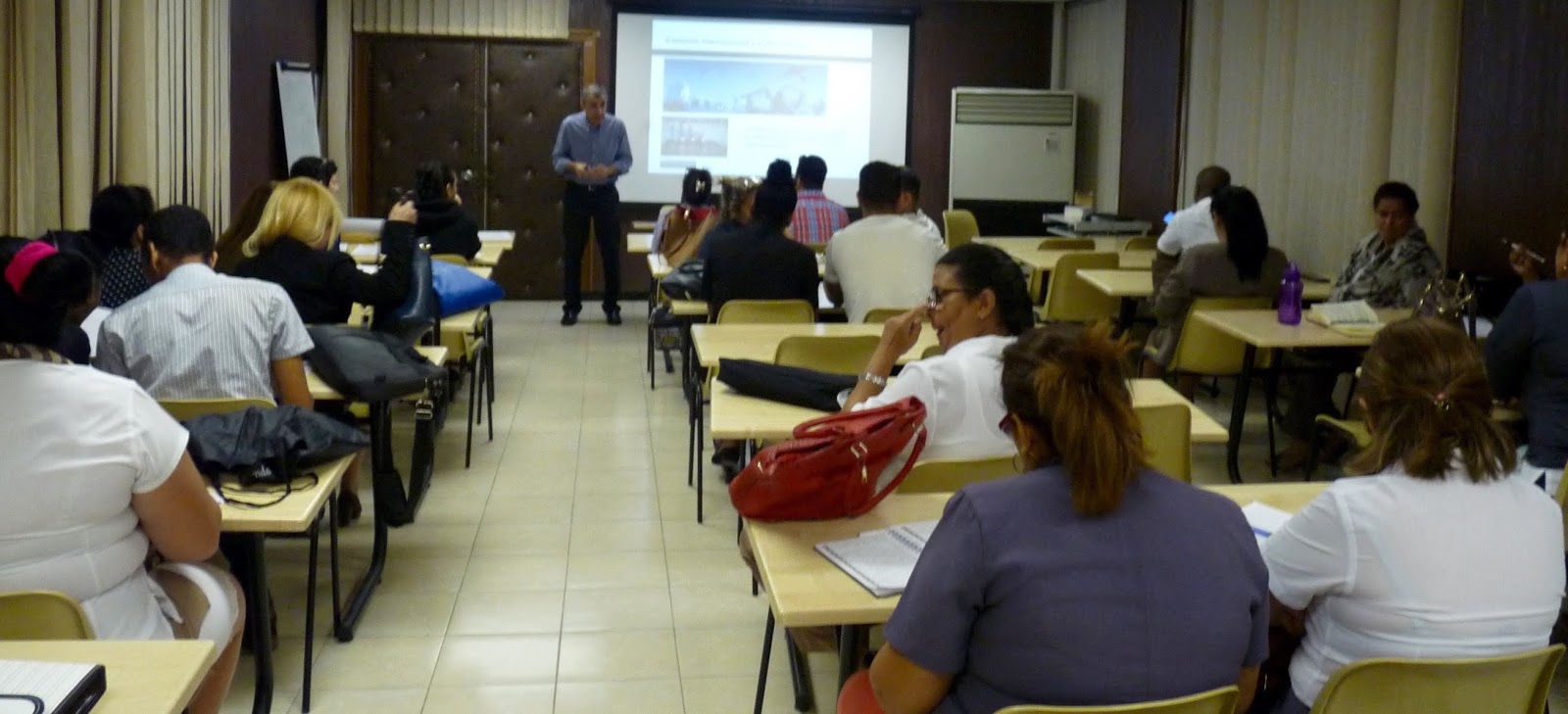
On 11th December, 2020, I had the honour of delivering a webinar for ProEcuador, part of the Ministry of Commerce of Ecuador, on the subject of International Trade and Methods of Payment.
14.12.20
11.7.20
Webinar for BID Intal (Interamerican Development Bank - IDB)
An honour to have been asked by BID Intal, part of the Interamerican Development Bank (IDB), to deliver a webinar on Trade Finance for Latin American SMEs.
You can watch the webinar at this link.
5.4.20
Cuba and the establishment of the GATT
Hi!
Answer to a weekend´s brain-teaser I posted in LinkedIn:
Where and when was the photograph taken?
- Havana (Cuba), November 1947
What was the event?
- United Nations Conference on Trade and Employment for the establishment of an International Trade Organization (ITO).
The ITO was not established, but the conference set the basis for the establishment of the General Agreement on Tariffs and Trade (GATT) in 1948.
Take care!
2.4.20
Thank you to all Trade Finance professionals
Dear Friends,
I hope that you are all well.
Amongst those professionals that are still travelling to work in order for the system to run smoothly, lets also thank those that work in the trade finance departments of companies and banks.
The digitization of those trade instruments that support international trade, is not complete. In the meantime, under a documentary credit, for example, exporters still have to send original documents that are received and checked by a bank, before being forwarded to the issuing bank and the importer.
My thanks to all these professionals.
Publicado por
PF
9.11.19
Incoterms® 2020 presentation in Lima
On 7th November 2019, I had the pleasure of addressing members of ADEX, the Association of Peruvian Exporters, in Lima, on behalf of ICC Academy to talk about the contribution of the Incoterms® to global trade and present the Incoterms® 2020 Certificate (INCO).
The Incoterms® 2020, published by the International Chamber of Commerce, will come into effect on 1st January 2020 and this revision includes:
You can watch the presentation here.
The Incoterms® 2020, published by the International Chamber of Commerce, will come into effect on 1st January 2020 and this revision includes:
- more detailed explanatory notes and a more detailed explanation on how to choose the most appropriate Incoterms® rule;
- on-board notation and the Free Carrier (FCA) Incoterms® rule;
- different levels of insurance coverage in Cost Insurance and Freight (CIF) and Carriage and Insurance Paid To (CIP);
- arrangements for carriage with own means of transport in FCA, Delivered at Place (DAP), Delivered at Place Unloaded (DPU), and Delivered Duty Paid (DDP);
- change in the three-letter name for Delivered at Terminal (DAT) to DPU; and
- security-related requirements within carriage obligations and costs.
You can watch the presentation here.
16.7.19
4th International Financial Summit, Panama
On 11th and 12th July, I had the pleasure to represent The London Institute of Banking & Finance at the 4th International Financial Summit in Panama, organised by the Panama Banking Association.
I also had the honour of being asked to deliver a presentation on the subject of Financial education in the age of Fintech, that can be seen in this link.
My thanks to the Panama Banking Association and to the British Embassy in Panama for their support and sponsorship.
I also had the honour of being asked to deliver a presentation on the subject of Financial education in the age of Fintech, that can be seen in this link.
My thanks to the Panama Banking Association and to the British Embassy in Panama for their support and sponsorship.
Publicado por
PF
Etiquetas:
Financial Education,
FinTech,
LIBF,
Panama,
Panama Banking Association,
UKinPanama
14.5.19
Lima Fintech Forum 2019
It was great to be able to attend the Lima Fintech Forum 2019 on the 8th and 9th of May, which has been organised by the Start-up Centre of Universidad del Pacifico, EmprendeUp, since 2017.
The event brings together representatives from fintech, banking, insurance, compliance, cybersecurity and digital transformation and innovation from all over the world but especially from Latam.
The topics discussed included: Financial system regulation for fintechs and comparisons between different countries; presentations by Latam fintech associations; blockchain and digital transformation; microfinance; crowdfunding; the drive towards cashless societies; and relationships between incumbent banks and fintechs.
This year there was quite a representation from the UK, with presentations by:
- Rory O'Kane, Fintech Trade and Investment Associate, UK Department for International Trade.
- Anna Cave-Bigley, Investment Manager for North LatAm (Colombia, Peru & Ecuador), Department for International Trade (DIT)
- Carlos Figueredo, CEO, Open Vector
- Nadia Costanzo, Banking Lead Latam, TransferWise
- In addition, Francine Torbett, Director of Trade and Investment - British Embassy, Lima, closed the first day of the event and also presented the UK Fintech State of the Nation Report, together with Rory O'Kane and Anna Cave-Bigley, during a side event.
The ubiquitousness of mobile phones, together with financial exclusion, provide opportunities for Fintechs in Latam. Add to this, the high cost of credit, if it is available, to both consumers and SMEs, and one can see a bright future for those Fintechs that can design and offer the right product. Fintechs involved in personal financial management should also get a fillip from the introduction of Open Banking in the region.
And talking about banking, or rather incumbent banks, and their relationship with fintechs, looks like a case of “if you can’t beat them, join them…or buy them” or as Rick said to Captain Renault in Casablanca:
"... I think this is the beginning of a beautiful friendship."
23.4.19
A mention in International Banker
A mention in an article written for International Banker magazine by Alastair Tyler, International Director of The London Institute of Banking & Finance.
1.4.19
Workshop in Havana - Guarantees in International Trade
Last week I was in Havana, where I delivered a
workshop on Guarantees in International Trade, on behalf of The LondonInstitute of Banking & Finance.
The workshop was organised by the Cuban CentralBank and held at their training centre, the Centro Nacional de Superación
Bancaria. It was supported by UNDP, Cuba.
My thanks to all that helped in the
organisation and especially to the participants, who were very welcoming. A great experience.
Publicado por
PF
Etiquetas:
Banco Central de Cuba,
Centro Nacional de Superacion Bancaria,
Cuba,
Financial Education,
LIBF,
The London Institute of Banking & Finance,
Trade Finance,
UKinCuba
21.11.18
Retail banking course in Havana
In Havana, where I recently delivered a course on retail banking on behalf of The London Institute of Banking & Finance, at the banking school of the Central Bank of Cuba, with participants from Cuban banks. The course was organised by the British Embassy in Havana under the UK Prosperity Fund. A very gratifying experience, with a very interested audience.
Havana International Fair - FIHAV2018
Visited the Havana International Fair - FIHAV2018, that took place between the 29th October and 2nd November, 2018. The fair is the second largest in Latam and the U.K was represented.
![]() |
| FIHAV2018 |
![]() |
| At the British Ambassador´s residence. |
7.11.18
Trade Finance course in Havana
In Havana, where at the end of October 2018, I delivered a course on international trade finance on behalf of The London Institute of Banking & Finance at the banking school of the Central Bank of Cuba, with participants from Cuban banks. The course was organised by the British Embassy in Havana under the UK Prosperity Fund. A very gratifying experience.
Publicado por
PF
Etiquetas:
British Embasy Cuba,
Cuba,
Financial Education,
Havana,
LIBF,
Prosperity Fund,
Trade Finance
11.10.18
Collaboration with The ICC Academy
Very glad to announce that we have started to collaborate with The ICC Academy, the educational arm of the International Chamber of Commerce, to promote their trade finance courses and certifications in Latam.
More to follow soon. In the meantime, if you require any information about the courses please contact us.
20.6.18
CLACE 2018, Panama
On the 7th and 8th of June, I attended the 34th Latin American Foreign Trade Conference held in Panama, representing The London Institute of Banking & Finance.
A good opportunity to meet with friends and colleagues, and to discuss the latest developments in Trade Finance in Latam.
LIBF presentation at ICC, Panama
On 6th June, I had the pleasure of delivering a presentation to a group of banking representatives at the offices of the Panama Banking Association, at an event organised by The London Institute of Banking & Finance and the National Committee of the International Chamber of Commerce (ICC) in Panama.
The event was organised to present our Trade Finance Certifications, namely, Certificate for Documentary Credit Specialists (CDCS®), Certificate for Specialists in Demand Guarantees (CSDG®) and Certificate in International Trade and Finance (CITF®), which were designed in collaboration with the ICC.
Very glad to see so much interest in our educational offering, and in particular, our Trade Finance Certifications.
My thanks to the participants, the Panama Banking Association, Yhordis Velarde, Chairperson of the Foreign Trade Commission; Trade Finance Head of Banco General; and Member of the Board of ICC, Panama; and to Karla Turner, Secretary General of ICC, Panama.
Until next time, Panama!
The event was organised to present our Trade Finance Certifications, namely, Certificate for Documentary Credit Specialists (CDCS®), Certificate for Specialists in Demand Guarantees (CSDG®) and Certificate in International Trade and Finance (CITF®), which were designed in collaboration with the ICC.
Very glad to see so much interest in our educational offering, and in particular, our Trade Finance Certifications.
My thanks to the participants, the Panama Banking Association, Yhordis Velarde, Chairperson of the Foreign Trade Commission; Trade Finance Head of Banco General; and Member of the Board of ICC, Panama; and to Karla Turner, Secretary General of ICC, Panama.
Until next time, Panama!
Publicado por
PF
Etiquetas:
ICC Panama,
LIBF,
Panama,
Panama Banking Association,
Trade Finance qualifications
10.5.18
Capacity-building programme in Cuba
An article about Cuba in Global Government Forum, that refers to the capacity-building programme for Cuban bank executives, in which I participated with The London Institute of Banking & Finance,
19.4.18
ICC Banking Commission Annual Meeting, Miami, April 2018
Link for the presentations from the ICC Banking Commission Annual Meeting held in Miami, April 2018.
15.4.18
ICC Banking Commission Annual Meeting, Miami, April 2018
Between the 4th and the 6th of April, I attended the Annual Meeting of the ICC Banking Commission in Miami.
With the theme “Navigating trade in a world of disruption” the various presentations and roundtables, touched upon the issues that are central to trade finance today.
Here are some of the titles of the presentations that will give an idea of the issues discussed:
- Managing and Thriving in the ‘New Normal of Uncertainty’, addressing the concerns over protectionism.
- Disruptive Technology and the Future of Trade, discussing the new digital economy and trade finance, and the advent of FinTech and new players entering the market.
- Trade Trends and the Changing Perception of Risk, specifically, correspondent banking and derisking.
Publicado por
PF
Etiquetas:
FIBA,
FinTech,
ICC Banking Commission Annual Meeting,
Miami,
Trade Finance
1.4.18
A few notes on financial inclusion
A few days ago, I was asked about financial
inclusion, and I wanted to share the notes I made on the subject.
The
first question that came to mind was: what is
financial inclusion? or rather what do we mean by financial inclusion? Is it:
- Having a current account and a debit
card?
- Having access to credit?
- Making sure that everybody knows how to
manage their finances?
The second
question was, why is it that large parts of the population, in certain
countries, and a total of 2.5 billion people globally, are excluded from the
financial system?
- Is it because they do not have physical
access to a bank?
- Is it because the banks do not consider
them as a risk free and profitable customer?
- Is it because people don’t trust banks?
- Is it because people work in the informal
economy and, thus, would not enter into a banking relationship that could
attract the attention of the tax authorities?
(I should also mention that the issue of
financial inclusion is not confined to those countries that have a large
percentage of their populations living below the poverty line. It is an issue
that also affects the US, as I read in a 2016 article published by the White House.)
The third
question was, what do the different players want to achieve with increasing
financial inclusion of the world population?
- Is it a genuine desire to include
everybody in the financial system so that they have access to credit and a
secure way to conduct their finances?
- Is it a genuine desire on behalf of governments
to equip their citizens with the financial education necessary to make informed
financial decisions, participate in the productive economy and, thus,
contribute to their countries economic growth?
- Is it just a means for banks to rein in
more customers and make more profits?
I suppose that the answer to all of the
above questions is: Yes, or rather, that the answer is a mixture of all of the
above, depending on who is answering.
Notwithstanding the above questions, and
the objectives/reasons of the different actors, what appears to be true is that
technological innovation and, more specifically, innovation in mobile
communications coupled with the development of FinTechs that are challenging
traditional banks, are playing a crucial role in financial inclusion by
providing Mobile Financial Services at lower costs to consumers.
Having said that, the price of accessing
mobile communications could present a problem for low-income groups, that could
be augmented if they live in regions where cell phone coverage may be an issue.
31.3.18
Banking: To adapt or die...or to die trying
In
December, 1995, I was asked to write an article on the future of banking for a
small Spanish magazine - Mundo Español - published in London. Today, reading
about the "demise" of banks because of the "fintech
revolution", I had a feeling of déjà vu and
thought I would share the article I wrote all those years ago. Hope you enjoy!
To adapt
or die...or to die trying
The spate
of mergers and acquisitions that have taken place within the banking sector
since the beginning of the year, may have made bankers reminisce, some
maybe with nostalgia, about the late 1980's and the fireworks over the
Thames to celebrate the liberalisation of the London Stock Exchange -the Big
Bang.
Then, banks
and stockbrokers jostled with each other as they tried to secure a prominent
position in the market by merging with or acquiring the dealer and broker firms
operating in it, or by enticing away whole teams of brokers with the offer of
astronomical salaries -something very welcomed by the owners of the watering
holes in the City, as these individuals promptly invested sizeable chunks of
their windfall in these establishments. The frantic activity that ensued in
London, as in other financial centres, was boosted by the merger mania in the
corporate sector, and continued until Black Monday in October 1987.
This time
round, some of the reasons given for the mergers and acquisitions may be
the same and will probably mention synergy, economies of scale or
competitiveness, but now they are taking place in the wake of a recession, and
the atmosphere is one of gloom rather than self-congratulation.
In the U.S
alone, 277 mergers and acquisitions have taken place since the beginning of the
year. In August, the merger between Chemical and Chase created the country's
biggest bank with assets of $297 billion. In March, Mitsubishi Bank and Bank of
Tokyo sealed a merger creating the world's biggest bank with assets of $700
billion. In the U.K, Swiss Bank Corporation bought the investment banking
business of S.G.Warburg, Dresdner Bank bought Kleinwort Benson, and recently
Lloyds and TSB have agreed to merge, to mention but a few examples.
What are
the reasons for all these mergers and acquisitions? There are many, but the
main one is "financial disintermediation". Traditionally, banks have
had a virtual monopoly as intermediaries in the financial system; they accept
deposits (appearing as liabilities in their balance sheets) and make loans
(which appear as assets), with the peculiarity that most of those deposits are
liquid since they have to be repaid on demand, and most of the loans are
illiquid since they are granted with maturities in the future.
This
"intermediation" is sustainable as long as savers continue to channel
their money to the banks, and borrowers do not default. What has been happening
in recent years is that banks, on the one hand have been confronted by the
proliferation of non-bank financial intermediaries in the form of investment
funds, insurance companies, and even the financial arm of department stores,
competing to attract the money from savers and investors, and on the other have
suffered losses as a result of loan defaults and/or bad management. Even their
traditional business of lending to corporates has been hit by this process of
disintermediation, as companies have increasingly resorted to the capital
markets to raise funds.
In view of
all this, analysts and academics have for some time been speculating on
whether we are witnessing the slow agonising death of most banks, to be
replaced by a myriad of financial intermediaries specialising in specific
areas, and those banks which are deemed necessary for the smooth functioning of
a modern financial sector.
Whether
this scenario is probable depends, to a large extent, on how we define what a
bank is. The process of disintermediation and the competition from non-bank
financial intermediaries have forced many banks to adapt to the changing circumstances,
and they have done so in many different ways. In some cases the
transformation of a bank has been of such a magnitude that is has led to the
question: is it a bank or a financial services company offering bank
services? Today, many so-called banks derive a higher proportion of their
income from securities and foreign exchange trading, and fees, than they do
from the interest spread on their lending.
The picture
that emerges is a fuzzy one, if anything because in some countries a banking
group will own a retail banking operation concentrating on
"traditional" lending to individuals and small/medium companies
through a branch network, maybe another bank catering for large corporates and
engaged in investment banking activities, a securities trading operation, an
insurance company, etc.
In
continental Europe, for example, there is a tradition of universal banks
offering the whole spectrum of financial services, and with large shareholdings
in industrial companies that result in an intimate, and sometimes exclusive,
lending relationship. For a long time, these banks operated in oligopolistic
markets shielded from foreign competition by regulation and the high costs of
entry, but with the gradual removal of restrictions for foreign banks and the
onset of the Single European Market, some of them began to break ranks in order
to adapt and compete in a new environment. In Spain, Banco Santander took the
initiative by the introduction of the supercuentas in 1989,
and since then banks have fought fierce battles to keep or to poach each others
customers as new or revamped products have been introduced into the market
(investment funds, mortgage loans, personal pensions, etc.). During this period
there have also been a number of mergers and acquisitions, the two largest
of which created Banco Bilbao Vizcaya and Banco Central Hispano; the
consolidation of the public sector banks into Argentaria; and the majority
purchase of Banesto by Banco Santander after the collapse of the former in
December 1993.
What does
appear to be clear from the process underway in the banking sector is that
banks have to adapt or die. Some, like the American investment banks have for a
long time followed a strategy of providing specialised and innovative services
at a global level (admittedly, forced to some extent by the provisions of the
Glass-Steagall Act); others have opted to stay in their home markets trying to
become a dominant force by increasing volume through mergers and acquisitions;
some have sought new markets in the emerging economies; and yet others have
concentrated, more than most, in providing risk-management products and in
securities and foreign exchange trading.
Some will
succeed and others will, for various reasons, die trying like Banesto and
Barings -but as Kipling would say, that is another story.